




 124
124


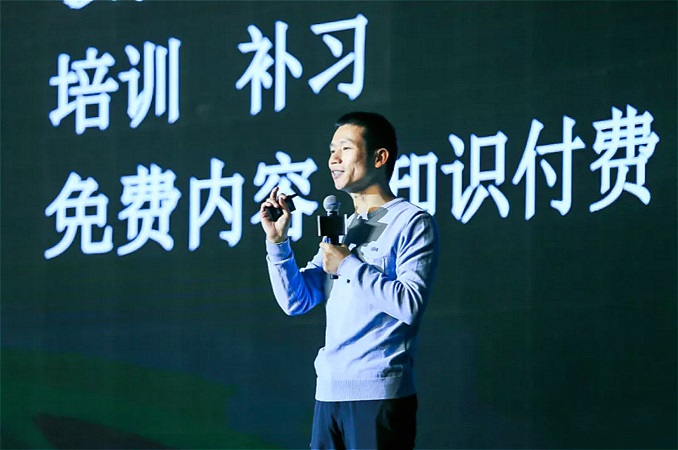
On November 13, at the GET2018 Education Technology Conference with the theme of "Collision · Evolution," Zhang Bangxin, founder and CEO of TAL Education Group, delivered a speech entitled "Promoting Educational Progress with Love and Technology" to the audience. In his speech, Zhang first deconstructed the three concepts of the education industry and the internal logic of its business model. He then emphasized that the essence of education is not technology but rather "the extent to which to help a student broaden his vision, solve his confidence, his confidence in learning, and the sense of achievement he gets from learning." Below is an excerpt from the speech:
Three Sets of Concepts
First, when we talk about education, we often combine several concepts together, and I would like to discuss them together:
Education and Learning. Education typically refers to a society's mandatory requirements for individuals, such as compulsory education for grades K-12. Compulsory education means that whether or not an individual wants to be educated, they must accept education—it is an obligation, a requirement imposed by society. Learning is from an individual's perspective. Each of us has a desire for learning from the bottom up, so it is not an obligation. Education is compulsory, but learning is not.
Training and Tutoring. In K-12, many training institutions also talk about education. However, education and training are not the same concept. Training typically refers to short-term learning that is not systematic or long-term; tutoring, on the other hand, is not entirely the same, and it deals with addressing areas where certain knowledge points are not understood.
Knowledge Payment, Paid Services, and Free Content. When online education emerged on the internet, many educational institutions offered various new concepts, such as tool-based apps, lots of free content and tools. In recent years, there has been the emergence of knowledge payment, as well as so-called live broadcasts, large classes, small classes, and one-on-one live classes, which are paid services. When we discuss any of these concepts, it's important to note that the education categories are rich and diverse, and what people are discussing may not refer to the same thing.
Thoughts on the Prosperity of Extracurricular Tutoring in East Asian Countries
Sometimes I ponder a question, and when we go to the U.S. to participate in the GSV, experts from other countries often ask the question: "Why is extracurricular tutoring so prosperous in countries like China, Japan, South Korea, and Singapore?" In my own research, I have found three main reasons.
The first reason is the significant influence of Confucian culture in these Southeast Asian countries. Combined with the millennium-old imperial examination system, studying has been considered a key to changing one's destiny in Eastern cultures. In the west, excelling in academics often doesn't hold the same level of significance. For example, in Europe and the U.S., academic prowess is almost a secret to changing one's destiny. This has led to a significant difference in societal perceptions. Moreover, due to the impact of traditional Chinese culture, many people believe that reading and studying well can change one’s fate. This aspect is closely tied to recognition in society—most people don’t want to work as delivery drivers or messengers despite the stable high earnings of several thousand dollars. This is a direct link to the traditional Chinese culture.
The second factor is the high population density of East Asian countries like China, Japan, and South Korea. High population density brings about typical pressures. Today, adults are caught up in checking off a list—learning vocabulary, reading, exercising. The effects of such behaviors on the people around us are immense. There's a saying: "While one friend is losing weight, the next is waist training." Specifically, in the U.S. and Canada, especially in the central and western regions, there are vast areas with low population density and a lack of competitive pressure and oppression.
The third factor is the economic growth rate, which brings with it the shift in human destinies. This generation’s shift in destiny, the high-intensity competition of adults in the world, brings that sense of competition back home, transferred to the next generation. As we see Europe having a relatively slower economic growth, the U.S. having a higher gro've all experienced different impacts of education in the East Asian culture, and this is how they link together.
Three Types of Business Models Determined by Three Costs
When we are studying the business models in the current main educational industry, we look at the educational products that clients are using. First, we look at what the clients need to invest in before what we provide them with.
Clients have three cost factors: 1) economic cost; to learn something, money must be spent, although there are products that are free and don't have an economic cost. 2) time cost; All products require a larger investment of time, a bigger cost than economic costs. For example, taking an offline tutoring class costs two to three thousand yuan for one semester, with classes requiring four to fifty hours, based on a thirty-hour timeframe. If homework and revision are also included, the time cost becomes significant. 3) Opportunity cost, which is far greater than the first two costs. Getting into a good school or pursuing excellence is irreversible, typically only available once. Due to this, its cost is far greater than the sum of the first and second costs.
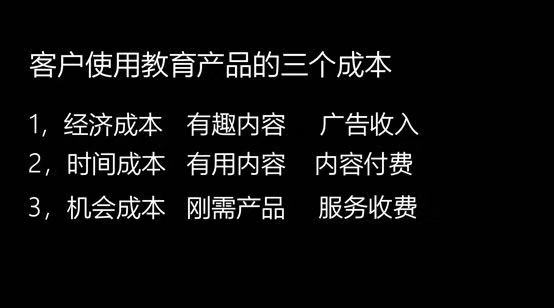
After studying these three costs, we have come to an understanding that they determine three things. The opportunity cost determines products in high demand—some subjects or courses are seen as very high in demand nowadays, such as improving students' grades, cultivating good study habits, and preparation for further education. Products that are mainly prompted by demand, and for which customers and users are primarily concerned, are of course not just based on economic and time costs, one-one-one tutoring services have become more popular for this reason.
The time cost corresponds to useful content. Many such products in the market are paid, including tiered reading and lighter courses, as well as various other paid contents, and knowledge-based payments. Products that provide useful content that users appreciate usually have fewer economic cost issues, but respect the importance of time cost for customers.
Finally, there is a category of products that feature interesting content. Customers are concerned about economic costs if the product can make them happy. In an ideal scenario, it should be free of charge. Based on these three categories of contents and products, there are also different corresponding business models. Interesting content usually corresponds to advertising revenue, based on selling advertising to a large number of users; useful content usually corresponds to paid content models, while products that are highly in demand correspond to service charges. These three products have distinct genetics. When many entrepreneurs enter this field, including many traditional training institutions and traditional educators, when they face this wave of challenges brought on by the Internet, many may not know exactly what they are doing. But in reality, if they sit down and carefully think about the fundamental needs of customers, and understand their own unique advantages, they can succeed fully because pure Internet models are not entirely identical to pure service models.
Future Star Trends
We must look at what will be valuable in the future.
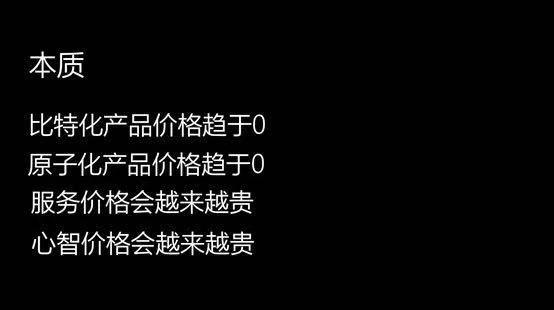
All digital products will tend toward a zero price in the long term. This is a widely accepted rule on the internet. Content may be charged for because it's based on limited time and limited audience, but it can also turn into paid content. However, in many industries, all standardized products and frequent repetitive products will eventually reach extremely low prices. This situation explains why hardware is valuable now, since it encapsulates complex human labor. Soon, the cost of hardware will decrease to be non-costly. This will change the paradigm in price, and indicates why human labor is valuable, and hardware is valuable. In theory, items such as cups, chairs, and smartphones should decrease to almost nil. Today's hardware is valuable due to human labor; but since human labor consumes one's life, it is limited and costly. This is why it holds value according to human limitations, and that's why a blanket price decrease will happen in the near future.
Time will be more valuable in the future, as services consume people's time, and time is a part of life. People's time is scarce and as a result, will increase in value. This goes for all scarce resources; even if human life duration is increasing, they will still become increasingly valuable.
All efforts of the mind will become increasingly valuable, due to their consumption of not just life, but of people's souls. This consumption of mental resources will increase in value over time. These four lines explain the three types of payment models I mentioned earlier, the three types being advertising revenue, content payments, and service payments. In the future, there will also be creativity and innovation payments, a less common product we see in the current market, but these will become significant in proportion in the future.
The Essence of Education is Not Technology
Therefore, from my perspective, in the interaction between technology and education, it's often said that technology is the essence, the Internet is the essence, and education is the essence. From this point of view, those working in education should be committed to adhering to the fundamental principles of education in order to avoid deviating from the right direction. Technology and the internet, instead of flood and rabid beasts, are here to help—their collaboration with education promotes self-improvement in educational teaching and activities. For the past five thousand years, this has been the case, and it will continue to be so in the future. The combination of education and technology empowers education, and the essence of education is not technology.
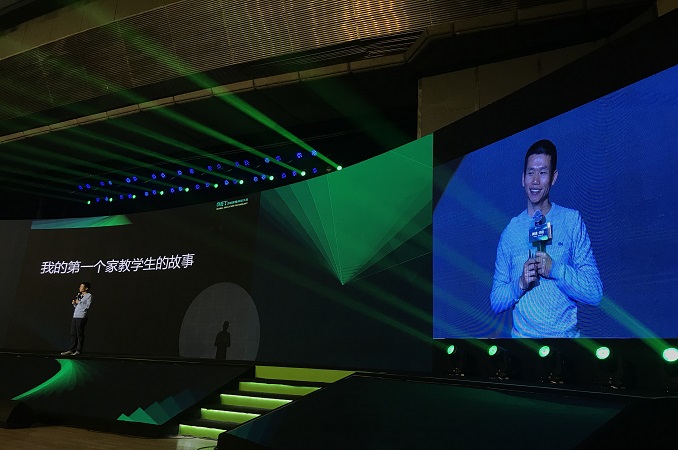
To illustrate this point, I would like to share a story from my days as a private tutor. The earliest version of TAL Education Group was born from the fact that when I was a graduate student, I was a private tutor for a student in sixth grade, teaching maths. The student was quite bright, and after a period of teaching, scored a hundred percent on maths exams three times. His father then introduced me to 20 other students, and soon enough, I had enough to form two classes, thus marking the beginning of TAL Education Group. I had always focused on teaching him mathematics because that's what I was teaching at that time. Recently, he came to my company because he has now graduated and successfully secured admission to Tsinghua University for his MBA. He asked me to write a recommendation letter for him. Due to his success, he managed to get through the interviews and secure admission to Tsinghua University. During our conversation, I had forgotten many details, but during our exchange, he said to me, "Teacher Zhang, I'm more grateful for something else." He said, "The way you taught me Chinese, reciting Chinese idioms and weaving stories around them was extraordinary, and playing idiom games with me." I felt somewhat embarrassed. He said, "It opened up my imagination, and it gave me a sense of pride, while our company has a value of 'being practical.' I felt somewhat embarrassed at the time, and I asked him, "What was the second most memorable?" He said, "The second most memorable instance was when I wrote a literary piece, a science fiction piece, and you inquired about the details. Which planet did it reach? What did the alien look like?" I was completely dazed because I had forgotten all these details. But I had taught this student 16 years ago, and he still remembered every single one of these details. I felt a bit reluctant, and I asked him, "What else did you find memorable?" He replied, "You were decent with teaching mathematics; you were very patient." I asked, "Anything else?" "No," he said.
This occurrence shook me deeply, for I realized that our communication and interaction with students are not about how much knowledge we impart. It's not about what methods we use, high technology, or big data to solve problems. More importantly, it's about how much passion and positive energy we transmit. It's about how much we care about them and how much we assist them, how much we help them broaden their vision, build their confidence, instil a confidence in learning, and how much achievement they receive from learning.
We defined the mission of TAL Education Group as "Using technology to promote educational progress." As a graduate of science, I have always been proud of "using technology to promote educational progress." TAL Education Group invests heavily in content and technology R&D, and we've been quite successful in this domain. However, when I engaged in a conversation with students, I was struck by the fact that despite these considerable investments, we have struggled to change the fundamental essence of education. It seems that meaningful changes in human interactions, the transmission of love and the exchange of souls, cannot be influenced by information technology, technology, data, or AI.
Using Dual-Teacher Models to Facilitate Traditional Offline Training
Earlier, I touched upon the domain of technology and the internet. Now, let's discuss the traditional offline training institutions. We see a trend that is gradually shaping up due to the rapid development of online and offline training institutions over the years. The trend is the emergence of horizontal platforms, which will provide water and electricity for specific areas to all institutions. For example, information systems, dual-teacher live courses, known as horizontal platforms connecting an array of institutions. TAL Education Group is also delving into such ventures, and we have signed hundreds of training institutions. Our model involves the output of key teachers for these institutions. Certain areas may not have the necessary expertise, but even if openings are available, we might just have to let them be. We aren't capable of doing all things, and our capabilities are limited. This endeavor serves a focal function, and it provides the open platform with varying dimensions from regional institutions that cater to products.
For instance, one institution might not have an overseas education subject, but they can easily adapt to a new subject; a subsequent institution could easily teach mathematics by incorporating a dual teacher for two subjects instead of just one. Subsequently, a small-scale primary school, for instance, that offers lessons in language, math, and science, can even offer lessons in junior middle and high school. The institution can soon adopt programming products and instruct students across all subjects. Nevertheless, the institution maintains a very high teaching quality. This is the industry's forward-thinking that has revolutionized traditional small-scale operations.
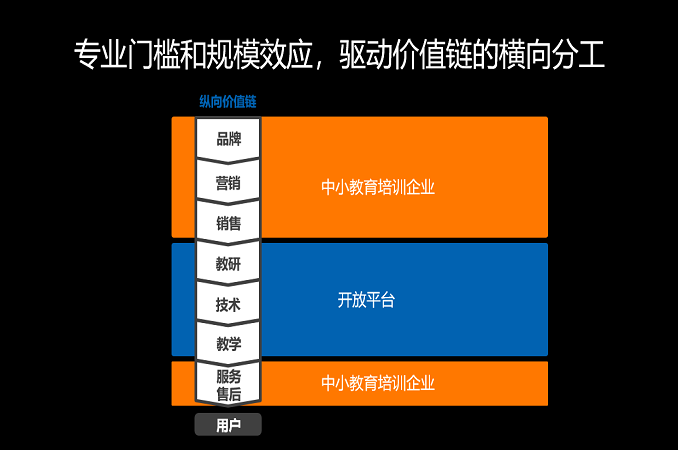
Looking at the bigger picture, these institutions will be linked to a "vertical industry chain" within one organization. This will incorporate multiple areas such as brands, marketing, sales, educational research, technology, teaching, services, and after-sales—these enterprises often function independently. However, due to industry changes, various roles are crossing boundaries and there is a range of companies developing cross-industry open platforms. These companies, mainly focused on the output of educational research, teaching, and technology for the national primary and secondary training institutions, will become frequent in the coming years. TAL Education Group is currently addressing this industry, and we are implementing various open platforms for our businesses. Many institutions have traditionally viewed our company as a direct competitor, but in the future, we have to become part of a collective whole.
The premise for these changes is technological advancement. For example, our dual-teacher products at TAL Education Group started in 2013. This venture began online. Our internal discussion about building this product attracted two to three thousand students within two to three years, significantly impacting our product TAL Online students.
Our internal competition holds value, and we are looking to further our successes subsequently.
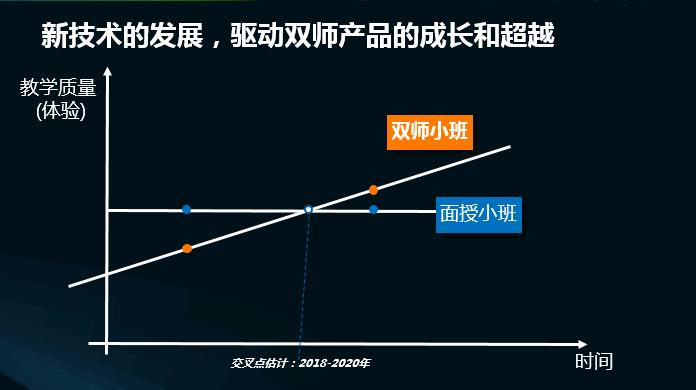
Every institution is different—our goal is to supersede expectations between 2018-2020. For TAL Education Group, this timeframe is crucial. We firmly believe that the future of dual-teacher models in education will exemplify exemplary teaching/knowledge services. Small classes are relatively stable compared to dual teachers, and the product will require a lot of refining and iteration. It's expected to evolve more efficiently. So far, our students have presented data to support this claim.
Moving forward, we want to put the focus on teachers who enroll in our institution. These individuals should aim for specialized training, just like today's medical professionals. Whether it's an orthopedic or a dermatologist, they will train students to inspire confidence, encourage enthusiasm, answer questions promptly, and develop curiosity autonomously. All educators will also contribute drastically to student development in these themes. We look at our institution and students—today,