




 120
120


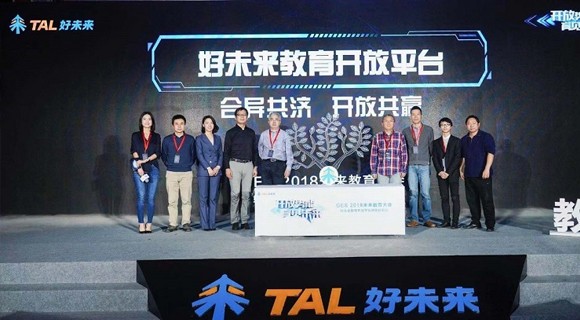
On the afternoon of December 4th, at the GES2018 Future Education Conference, Liu Yachao, the co-founder and COO of the Good Future Education Group, engaged in a thematic dialogue with Apple's co-founder, Steve Wozniak, on the theme of "Education and Technology: The Future Symbiotic Relationship?"

Liu Yachao, co-founder and COO of the Good Future Education Group, makes brilliant points
Key Points:
As technology such as the Internet and AI continue to develop, all work based on logical deduction may be replaced. However, teachers not only bear the responsibility for knowledge and skills but also for their behavior, values, and emotional expressions, which can help or guide children in their cognition and cannot be replaced by technology for a considerable period of time.
The Internet has already been changing education, and with the arrival of the 5G era, VR will have a significant impact on education, transitioning many teaching activities from the physical world to the virtual world. Additionally, advances in biology and neuroscience are likely to have a huge impact on education and help it achieve customization and personalization. Therefore, technological progress is likely to promote the transformation of the entire education system, ultimately achieving personalized education.
Educational "structuring" may see three changes. Firstly, the teaching path will change, and technology can support personalization by incorporating knowledge, questions, and the characteristics of children at the "bottom." Secondly, the teacher-student ratio will change, with AI becoming an assistant to teachers and allowing teachers to focus more on guidance and innovation. Finally, the assessment of teaching will change, allowing for multiple answers and possibilities, encouraging children to solve problems through innovation.
Countries and institutions should collaborate more effectively and share their best practices in education and life. This can be realized in two ways: first, utilizing third-party platforms such as the Internet to establish standards and improve the flow of educational resources, and secondly, utilizing economic power to reward the people who share innovative results to provide them with incentives.
The greatest challenge in education is the significant changes in human needs in social development. Education, to a certain extent, can be said to be putting past knowledge through memory and repetitive practice into the brain. However, what society needs more is innovative and versatile talent. Education should invest more in innovative exploration and encourage children's self-awareness.
Technology is the speed of social development, and education is the acceleration of social development, both of which are extremely important to the entire society.

Liu Yachao, co-founder and COO of the Good Future Education Group (right) with Apple's co-founder Steve Wozniak (left) engaged in a thematic dialogue
Below, the live transcript:
Liu Yachao:
Firstly, on behalf of Good Future, I welcome everyone, especially Steve Wozniak, to participate in the GES2018 Future Education Conference and discuss the issue of the symbiotic relationship between technology and education.
I myself used to be a math teacher, and later I started to work in educational management. Good Future's mission is to "advance education with technology." Therefore, we have spent a lot of effort studying how new scientific technologies can empower education, and we have established the AILab, Brain Science Laboratory, and Big Data Center.
Steve Wozniak's experience is legendary. As we all know, he is an outstanding engineer who developed the Apple I and Apple II in the 1970s, changing the entire PC era. However, many people may not know that Steve Wozniak taught at public schools as a primary school teacher for eight years. So I would like to ask, why would you, already a very outstanding engineer, want to become a teacher?
Steve Wozniak:
When I was young, my father instilled in me a noble value that schools and education are important paths for everyone to strive for the future. I felt I have to be a teacher, and also, I am very curious and want to explore, so school education is very valuable to me.
When I was very young, I told my father that in the future, I want to be an electrical engineer just like him, and at the same time, I want to be a fifth-grade teacher, because my fifth-grade teacher once made me feel important. Therefore, throughout my life, I always thought, I have to teach children because they are very important. They represent the future of the world.
At that time, I was particularly interested in the psychology course in college. In the teaching process, we can influence the psychological presence of children. Later, when I had my own children, I brought a computer to their school. I didn't have a lot of money, but giving money alone does not create value. As a teacher, donating your time is the most important thing.
So I became a teacher at the middle school, and I taught 8 years at a local elementary school, teaching 7 days a week. I was quite good at that time, and was a "star" math teacher. I didn't want my students to read a lot of periodicals and articles, and all the courses were prepared by myself. This is the real creativity.
Liu Yachao:
I think being a teacher and engineer are two different roles. An engineer can develop new products that meet customer needs, which is a form of self-innovation. While a teacher is more about inspiring and guiding students, about exploring and learning new knowledge. Do you think there is any connection between the two? Is there any meaning in mutual learning from each other?
Steve Wozniak:
Yes, they have very different roles. When you are a teacher, you need to have good interpersonal skills. However, you need not only to express your thoughts but also to consider students' perspective, whether what you say can be understood, and whether the student can learn from it.
Being a teacher for a few years, I have accumulated valuable experience. When I taught classes, if students could not accept, experience, and enjoy the content, it was actually meaningless. You should ensure that what you provide can motivate them and make them want to learn more, making the class enjoyable. I think if you really want to inspire children, you have to be willing to challenge.
I would like to turn the question back to you. Technology in the future may replace many so-called low-skilled occupations. What does that mean for educators?
Liu Yachao:
Technology has always been replacing human work and empowering humanity. From the agricultural era to the industrial era, many repetitive jobs have been replaced. With the development of the Internet, AI, and other technologies, jobs that can be deduced logically may all be replaced. As teachers, we need to move beyond the past of imparting knowledge, questions, and problem-solving methods and focus more on teaching the reasons behind these things. This process of acquiring new knowledge is crucial. We need to teach them how to learn and understand the world.
Also, as teachers, we have a responsibility not only for knowledge and skills but also for our behavior, values, emotional expression, and viewpoints on many issues, which can help or guide children in their cognition. For a considerable period of time, we are irreplaceable by technology.
Steve Wozniak:
I completely agree with your understanding.
Liu Yachao:
When I read your autobiography, I saw that you helped your child's classmate with his homework. When he encountered a difficulty, you motivated him by saying, "If you study hard, you can use the computer to submit your assignments." He was very encouraged by this. Earlier, you mentioned that you were very popular in the classroom - what do you find to be the most important in the educational process and what is the ultimate goal of education?
Steve Wozniak:
I am very fortunate because I dedicated myself to teaching full-time, teaching in primary school every day for eight years. However, I was also a so-called "volunteer" teacher. My courses were planned after school, and only students who volunteered could take my courses. I wanted to reinvigorate my students. At that time, computers were bulky and cumbersome. There was a girl who didn't like to study. I took her to my home and taught her how to use the computer for several weeks. I spent two hours each day telling her how to print a report on the computer. Compared to writing with a pen, which took other students 20 minutes, she took two hours. She became passionate about learning after this experience. If I could solve a child's problem, then I could help other children as well.
At the same time, our learning was "learning through play." Both my students and I could communicate through the internet. At that time, my school was connected to the American Online network, so I could tell them how to update the computer system, how to make their homework look beautiful with the help of a computer. When I encourage and praise you, you will be motivated, and you will want to learn more and love learning more. I never wanted my class to be boring. If they did not understand one day, I would modify the teaching method the next day.
So I would like to ask you a question. Apart from AI, what other emerging technologies have a significant impact on education?
Liu Yachao:
The Internet has already been changing education, with many online education companies providing an abundance of educational resources. However, with the arrival of the 5G era, VR will also have a significant impact on education. The Internet solves the problem of geographical separation in education. An English teacher from the United States can teach Chinese people to speak English, and a famous math teacher in Beijing can teach children from remote mountainous areas.
VR can possibly transform a two-dimensional world into a virtual three-dimensional world. We spend a lot of time using smartphones and other smart terminals. In the PC era, it might have been only one hour, but now it might be four or five hours. I predict that in the VR era, this time could be reversed. We might spend 70% of our day in the virtual world. In the education industry, many teaching activities may shift from the physical world to the virtual world. For example, we could be sitting in the United States and China, yet still be attending the same GES Future Education Conference. Therefore, I think VR will have a significant impact.
Additionally, advancements in biology and neuroscience may have a significant impact on education. Education has been one-sided - we design curriculum and systems for all children to learn, but we have limited knowledge about each student individually, and we do not have a good understanding of which parts a child is inherently good or bad. We do not know the different ways of thinking for each child. Therefore, our education methods and content are not customized and personalized. Therefore, technological progress is likely to promote the transformation of the entire education system, ultimately realizing the so-called personalized education.
Steve Wozniak:
Thank you for your wonderful answers. I hope to be a student in the VR era.
Liu Yachao:
The education systems worldwide are very similar. What do you think is the biggest problem in the entire education system right now? What changes do you see in education brought about by technology?
Steve Wozniak:
The problems the education system faces right now have existed for hundreds of years. Students used to just learn quickly in the past, but now we should focus on teaching them to think and solve problems. We set exams, and the papers have the correct answers, but this does not foster creativity like in music, art, and other subjects. Therefore, we need to inspire students to think and pursue personal projects and interests, so as to enrich children's lives. Our computing teacher assistance project has empowered these students.
Once, I bought an Apple I and gave it to a woman. Later, she brought the computer to a primary school for education. I think that at that time, the computer was transformative in education, but it did not make people smarter. It was just a standard tool that schools had. So what contributions can technology make? If we have a computer teacher that is like a friend, that we can ask questions and who looks into our eyes to understand us and our lives, family, and favorite jokes, then it isn't just an educational device, but our friend. However, right now, such a computer teacher is not available, and it might not be in the future. Machines cannot think like humans, but we can make these young students feel like their teacher is their friend.
I think that for teaching, it is very important for a student to have a good teacher. I hope that one day a computer can be a good teacher like that, but now, we have not yet achieved that. Students can research a computer themselves, and their learning speed may be faster than before, but this is not a standard in schools.
Additionally, in schools, one class has one teacher and 30 students. This teacher-student ratio limits and restricts us because schools have limited budgets. Many years ago, the world decided that we should provide education to everyone, regardless of their social status, whether they are poor or rich, their gender or race, everyone should have access to education. If we had more budget, we could have more teachers and conduct longer projects to help students gain more educational resources.
So I have a question. You mentioned that education is highly structured - what can we do to promote students' creativity and thinking in different ways?
Liu Yachao:
I think this issue connects with your previous responses. You mentioned the "teacher-student ratio," as well as the current structural problems in schools. I feel that current education was shaped in the industrial era, and efficiency was emphasized. Everyone should receive education, but social resources are limited, so we can only use a 1:30 teacher-student ratio. However, this situation may exist in developed countries and regions, but in many other places, it might be 1:40 or even 1:50.
This is actually a paradox. We want to reduce the teacher-student ratio, and inspire and awaken children, but our resources are limited. You mentioned a computer teacher, as I understand, should be an AI teacher who can converse with students. Therefore, technology might effectively guarantee the supply of educational resources and reduce the cost of education to achieve new changes.
In terms of "structuring":
Firstly, we need to change the teaching path. Currently, our teaching path is a standard teaching process, and all children must complete the first, second, and third grades. I think they should be based on personalization, using technology to support personalization by incorporating knowledge, questions, and child characteristics as the "bottom."
Secondly, we want to reduce the teacher-student ratio. In the future, if we have AI teachers as assistants, they may be able to achieve personalized teaching. A part of knowledge impartation may be replaced by AI teachers, such as teaching a knowledge point or conducting an experiment. If there is sufficient logic, children can learn with the help of a computer, allowing teachers to focus on guidance and innovation.
Thirdly, we want to change the teaching assessment. Currently, our assessments are a closed question, which is a significant obstacle to innovative thinking, as children find answers from enclosed questions, and this is not encouraging innovation. Therefore, in the assessment process, we need to observe children's learning processes and make questions more open, allowing multiple answers and possibilities. Then, through the process and multiple results, we can encourage children to solve problems through innovation.
In any case, I think that if technology does not participate deeply and empower education, the innovative education we anticipate may only achieve a repeat of existing levels or be enjoyed by a small number of people with resources in society.
Steve Wozniak:
I completely agree with what you've said.
Liu Yachao:
You, as a renowned inventor known for innovation, if you assume that resources are unlimited, what kind of product would you invent to promote educational progress?
Steve Wozniak:
The product itself cannot bring about a significant change. Students have different professions when they graduate, and the courses that schools provide may not match what they want to do. We are giving them that freedom of choice. I turn the question back to you: everyone is discussing fair access to education curricula and standards - what do you think the biggest challenge is in education?
Liu Yachao:
I think the biggest challenge in education is the tremendous changes in human needs in social development. Technology has changed many industries, and more and more jobs no longer need humans. Calculation itself is a type of work, but computers are already highly developed. Education, to a certain extent, can be said to be putting past knowledge through memory and repetitive practice into the brain. However, what society needs more is innovative and versatile talent. Education should invest more in innovative exploration and encourage children's self-awareness.
Steve Wozniak:
I personally feel that many people, after graduating, may feel that they do not need to learn anything, and may settle for low-skilled jobs. However, there are no such jobs in the future, for example, machines like self-service kiosks are capable of replacing these low-skilled jobs. Therefore, if you really want to find a job, you must have a skill.
I'd also like to ask you, as a person willing to take care of your own business, why did you want to be a teacher? Also, what's the most