



 111
111


The report of the 19th National Congress of the Communist Party of China pointed out that "to run good education that satisfies the people" and "strive to ensure that every child can enjoy fair and quality education" and promote the modernization and balanced development of education is the general trend. On April 26th, the three-day 76th China Educational Equipment Exhibition was held at the Chongqing International Expo Center. TAL Education Group, along with its smart education products, appeared, integrating artificial intelligence with education to uphold the mission of ensuring that every child enjoys fair and quality education.
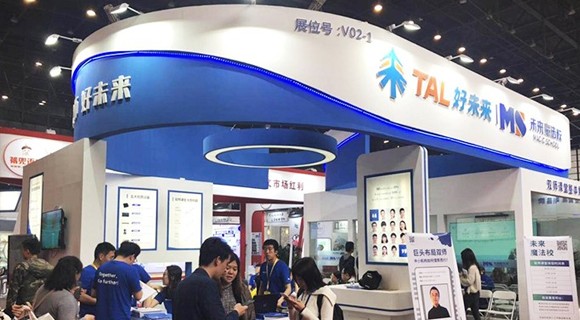
The China Educational Equipment Exhibition, hosted by the China Educational Equipment Industry Association, was organised by the Chongqing Municipal Education Commission and the Chongqing Municipal Commission of Commerce. The TAL Education Group's booth at the central hall was themed "Artificial Intelligence to Assist Quality and Balanced Development of Education", divided into several areas: smart management, precision teaching, personalized learning, and dual-teacher teaching.

Crowds at the TAL Education Group booth at the education equipment exhibition
In the morning of the 26th, Du Yubo, former Deputy Secretary of the Party Group and Deputy Minister of the Ministry of Education, and Wang Fu, President of the China Educational Equipment Industry Association, visited TAL Education Group's booth to experience and gain detailed knowledge of the latest applications of quality resources, knowledge maps, adaptive learning, and artificial intelligence technologies in the field of education.

Du Yubo, former Deputy Secretary of the Party Group and Deputy Minister of the Ministry of Education (center), visited TAL Education Group's booth, with TAL Education Group's President of Smart Education, Yu Li (left), explaining the products

Wang Fu, President of the China Educational Equipment Industry Association (center), visited TAL Education Group's booth, listening to the staff explain smart education
Smart Classroom: Behavioral Analysis to Support Precision Teaching
In a traditional classroom, a teacher faces dozens of students. Classroom exercises and collecting feedback on teaching information require relatively crude methods such as "individual inquiries". Students' interests, difficulties, and learning process data are hidden in a "black box", making it difficult for teachers to adjust teaching plans.
TAL Education Group's development of a lightweight smart classroom—pen and paper interactive classroom—has opened this "black box" through "human-computer collaboration", making classroom data transparent. The pen and paper classroom environment built with "handwriting pen + handwriting pad" not only retains students' habit of answering on paper, but also naturally collects students' process and result data in the classroom, uncovering students' learning processes. Based on behavioral data analysis such as student classroom pauses, it discovers students' learning habits, problem-solving approaches, and mastery of knowledge points. At the same time, teachers can view students' real-time responses to in-class questions, accurately analyze the learning situation of the whole class, and provide targeted explanations and layered guidance, truly achieving "teaching based on students' individual needs" in future schools.

Visitors at the TAL Education Group booth inquiring about the "pen and paper classroom" developed by TAL
Adaptive Learning System: Data-Driven Personalized Learning
The adaptive learning system analyzes teachers' teaching situations, students' pre-class preview quizzes, in-class quizzes, and homework data, and provides corresponding teaching improvement solutions based on the knowledge graph of the subjects. The adaptive learning system provides students with an all-in-one learning space that integrates learning resources, Q&A, assessments, and communication. Based on the data foundation of the data center, it constructs a platform to collect, track, and analyze students' learning. Through data collection, organization, integration, and intelligent push in a virtualized environment, it realizes data analysis and presentation.
Dual-Teacher Classroom: Boosting the Sharing of High-Quality Teachers
The dual-teacher classroom involves two teachers in the classroom—one is a high-quality teacher on the screen, and the other is the actual teaching teacher in the school. The high-quality teacher on the screen mainly provides students with training on knowledge points and skills, while the actual teaching teacher serves as a tutoring teacher, providing precise guidance and personalized teaching based on students' performance. Taking the example of the TAL WISROOM English for study English, it not only addresses the issues of local teachers' inaccurate pronunciation and lack of interaction, but also enhances students' interest and learning effects.

Audience experiencing TAL's dual-teacher classroom, interacting with online leading teachers and offline tutoring teachers
In 2018, the Ministry of Education officially approved Ningxia to be the first "Internet + Education" demonstration area in China, and began the "Artificial Intelligence Assists in Teachers' Professional Development Pilot Project." TAL actively participated in pilot construction in multiple regions and schools, such as Shizuishan City and Xixia District, using advanced artificial intelligence and big data technology to contribute to the development of the Ningxia Autonomous Region's education career.

A large number of visitors at the TAL booth listening to the staff introduce TAL's smart education business
In April 2019, the WISROOM English smart classroom equipped with TAL's products was completed and put into use in Xixia District. The school is trying out WISROOM's English with foreign teachers and dual-teacher Chinese language classes.
AI Teacher Mandarin Teaching System: Promoting the Popularization of Mandarin
At the exhibition, many people gathered around the "AI Teacher Mandarin Teaching System" to watch and experience the system practicing Mandarin. Based on the images and bilingual pronunciation hints on the system interface, the system can intelligently evaluate, score, and correct pronunciation in real time as the experiencer speaks words or sentences. After the practice, it generates a multidimensional learning data report.

Media reporters interviewing and experiencing the TAL AI Teacher Mandarin Teaching System
This system is also suitable for ethnic minority areas. Zhaoyue County in Liangshan Prefecture, Sichuan Province, is the largest Yi ethnic settlement county in China and a key county for poverty alleviation. In the area, there is a shortage of teachers who can fluently teach Mandarin. Not being able to speak Mandarin is the biggest obstacle for local children to communicate and learn with the outside world. The appearance of the "AI Teacher Mandarin Teaching System" has broken this deadlock. In September 2018, the system was implemented in 71 schools and 124 teaching points in Zhaoyue County. Speaking fluent Mandarin and then coming out of the mountains has become possible for local children. Currently, this system has benefited 60,000 young people in the area.
In addition to teaching Mandarin, the system also covers languages from several countries along the Belt and Road, such as Croatia and the Czech Republic. It combines the regional cultural characteristics to customize language corpus, presenting common words in a simple and understandable "picture + bilingual pronunciation" mode.
In the process of human-computer dialogue practice, the system can intelligently evaluate pronunciation in real time, score it, repeatedly correct pronunciation, and generate multidimensional learning data reports after practice. With this system that deeply integrates speech recognition and speech evaluation technologies, the problem of "speaking" in language learning is solved.
At this equipment exhibition, TAL also brought the "Future Cloud Resource Platform" covering K12 full-stage, all-subject learning resources, the "Prepare and Teach System" to enhance the effectiveness and reduce the burden of teaching for teachers, allowing each student to simultaneously receive attention from two teachers in the "Dual-Teacher Classroom," tools to help teachers reduce their workload in "oral calculation correction," "photo search for questions," and "intelligent test paper setting," as well as the "Future Home-School" for flexible communication between teachers and parents, and 12 other products.
TAL's Vice President of Smart Education, Wang Lu, stated that TAL Education Group has always adhered to the core belief that "teaching and research are the core, information tools are the support, and systems and mechanisms are the guarantee", combining TAL's high-quality teaching and research resources, platforms, services, applications, teaching and teacher growth management and other products with multi-level smart education cloud platforms of provinces, cities, districts, counties, and schools, to achieve the regularization of information technology applications, reducing the burden and enhancing the effectiveness of teaching in schools. Through the drive of artificial intelligence and big data, it ultimately achieves "teaching in accordance with students' individual needs" on a large scale, helping regions and schools to achieve fair and quality education.
Wang Lu, Vice President of Smart Education at TAL, stated that TAL Education Group has always been committed to promoting the progress of education through technology, and is dedicated to building a comprehensive educational technology ecosystem. The Group is fully committed to cultivating the core literacy of Chinese students, insisting on student-centered education, exploring the empowerment of "artificial intelligence + education" for regional and school education, continuing to focus on the progress of knowledge graphs, adaptive learning analysis technology, using information technology to promote the reconstruction of teaching and management processes, resolving the long-standing contradictions of "scaling" and "personalization" in education development, and promoting the modernization and balanced development of education.